Heirloom
First Person Horror Game
Role: All Design
2 Person | Jan 2026 – Current | Unreal Engine 5
Introduction
Heirloom is my ongoing capstone horror project—a first-person investigation game. Players take on the role of an intern paranormal investigator who is sent to a suburban house after a murder has taken place. Inside the house, you use a camera to document anomalies and cross into an “Inner World,” gradually uncovering fragments of the past and ultimately revealing the truth behind a 70-year-old curse.
This project is built on a reconstructed development foundation inspired by my earlier work, Out Of Frame, but it has been pushed much further in both scope and overall polish. My goal is to achieve a high level of polish while also introducing new mechanics and experiences into the classic linear horror pacing structure—so that the game feels grounded in proven design principles while still establishing a distinct identity of its own.
System Design
Situation
The project started as a horror prototype inspired by The Exit 8, built around a “find anomalies” gameplay loop. The goal was to create fear through observation, anomaly detection, and exploration. However, after playtesting, the experience often felt more like a visual “spot the difference” game than true psychological horror.
Building on my earlier project Out Of Frame, I wanted Heirloom to go further in scope, polish, and system design. My goal was to strengthen the core loop, support traditional linear horror pacing with stronger systems, and create an experience that felt both familiar and distinctive.


Task
In this project, I needed to solve three main problems.
-
First, I needed to redesign the core gameplay loop so the horror came from sustained pressure rather than simple visual recognition.
-
Second, I needed to build a system structure that could support narrative, exploration, threat, and pacing without these elements conflicting with each other.
-
Third, I needed to combine system design and level design to create an experience that felt tense but fair, while keeping players immersed and guiding them toward uncovering the story through exploration.
Action
To address the lack of fear in the early “find anomalies” prototype, I restructured the game into a dual-world framework that combines linear progression with sandbox-style exploration. The Surface World serves as a safe narrative hub, while the Inner World delivers chapter-based gameplay, threat, and survival pressure.
In the core loop, players explore the Inner World to complete each chapter and earn keys, which are then brought back to the Surface World to unlock new rooms. This structure separates high-pressure gameplay from calm investigation, allowing survival, exploration, and narrative discovery to support each other more clearly.
To reinforce pressure, I designed the Sanity system as a negative feedback loop that combines HP-like survivability with countdown-based urgency. In the Inner World, players must remain in lit areas to stabilize Sanity; once pushed into darkness, Sanity drains and danger escalates. This turns light from a visual atmosphere tool into a core survival mechanic.
I also introduced a Director system that dynamically increases tension by manipulating environmental elements, especially by shutting off lights and reducing safe space. To keep the experience intense but fair, I added safeguard rules, such as protecting lights that are currently illuminating the player.
For level guidance, I used paranormal events, sound cues, and lighting changes as subtle navigation language instead of relying on explicit UI prompts. Finally, I tied the ending to exploration by having players collect password fragments through room unlocking, leading to a hidden dark room and a major narrative twist. This allowed system design, level progression, and narrative payoff to reinforce one another.


Result
Through this redesign, the project’s core experience evolved from an early, relatively static, and observation-driven anomaly-recognition prototype into a linear horror exploration loop built around a dual-world structure. In simple terms, the loop is defined by a clear division between the Surface World and the Inner World: the Surface World supports reading, interpretation, and deduction, while the Inner World delivers a high-pressure horror experience centered on survival and exploration.
This separation allowed narrative discovery, spatial unlocking, pressure management, and chapter progression to be clearly distinguished and then reintegrated into a more cohesive overall loop.
Based on multiple rounds of playtesting and player feedback, this version of the system structure has proven to be the most well-received direction so far. It validated the design value of separating emotional pacing, narrative comprehension, and survival pressure into distinct layers, then connecting them through the core loop.
Through this project, I also came away with several key system design takeaways: effective horror is often built through the sustained interaction of multiple pressure systems rather than isolated scripted events. A strong core loop is not simply about making each mechanic work on its own, but about ensuring that progression, pressure, exploration, and narrative payoff reinforce one another as a unified experience.
Level Design
04

Task
My level design work on this project focused on three main goals.
First, I needed to transform the original looping structure into a level framework that could support linear narrative progression, allowing the space itself to carry chapter flow, story reveal, and emotional pacing.
Second, I needed to solve the problem of limited playable space while still supporting exploration, chase sequences, puzzle content, and horror event triggers, so the level would feel dense and meaningful rather than repetitive or cramped.
Third, I needed to build a highly immersive and psychologically oppressive horror experience through level design, relying less on direct jump scares and more on sustained environmental tension.


Situation
Heirloom’s level design originally followed a looping anomaly-based structure inspired by games like The Exit 8. However, as the project direction became more defined, that structure no longer supported the needs of a linear narrative experience. Instead of a repeated observation loop centered on anomaly detection, the game needed a hub-like level structure that could better support story progression, emotional pacing, and chapter-based gameplay.
The core challenge was that the main play space had to roughly feel like a believable small mansion while still supporting exploration, chase sequences, puzzle gameplay, and environmental storytelling within a limited footprint. In other words, I needed to create a layered and content-rich linear horror experience inside a space that still felt spatially coherent and realistically constrained.
Action
To solve the conflict between linear storytelling and limited space, we introduced the dual-space concept of the Surface World and the Inner World, then rebuilt the level structure around that system. Because players travel back and forth between the two versions of the same house, the level effectively became two usable spaces layered on top of one another. This allowed us to double the functional play space without breaking the logic of the core setting, which directly addressed the limitations of using a single residential environment.
At the level structure layer, I redesigned the chapter flow to support linear progression and was responsible for planning each chapter’s exploration beats, puzzle content, and horror event triggers. My goal was not to rely on frequent jump scares, but to use pacing, environmental implication, and atmosphere to create a stronger emotional curve. The key design focus was not only what happens in the level, but how the player is gradually led into discomfort, tension, and psychological unease.
To further improve spatial efficiency and flow continuity, we used level streaming to support chapter-specific scene changes. By loading different sub-level content across different chapters, we were able to create distinct experiences within the same physical footprint without repeatedly teleporting the player to entirely separate areas. This made the progression feel smoother and reinforced the idea that the house itself was continuously changing and revealing new information.
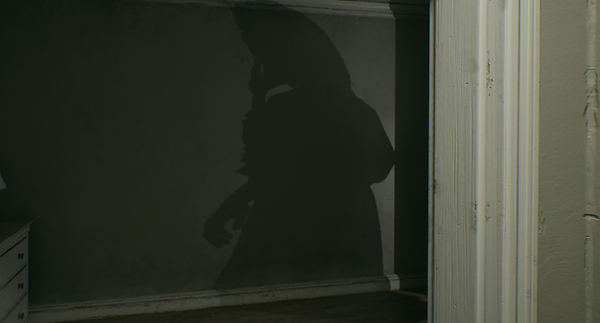
To create oppression and tension, I intentionally compressed the player’s navigable space so the environment would feel narrow, enclosed, and restrictive. At the same time, I tied many paranormal events directly to environmental interaction, such as a basketball rolling down from upstairs or a television suddenly turning on in another room. These moments do not always threaten the player directly, but they constantly break the sense of safety and encourage the player to imagine what may be happening outside their view. In many cases, this kind of environmental unease is more effective than explicit horror imagery because it allows players to scare themselves.
For narrative delivery, the level also carries traces of both a Chinese family and an American family. Through environment art direction, furniture style, and contrasting spatial details, I embedded both family identities into the same house. At first, players are likely to read the setting as a typical American household, but as they continue exploring, they gradually uncover signs of another family and begin piecing together the deeper truth behind the house. In this way, the level itself becomes not only a gameplay space, but also a vehicle for narrative reversal and discovery.

Early level structure sketches
Result
Through this redesign, Heirloom’s level evolved from a more repetitive, mechanic-driven anomaly loop into a hub-based horror level structure that better supports linear storytelling. The Surface World / Inner World framework not only solved the problem of limited residential space, but also created clearer functional separation between exploration, chase, puzzle-solving, and narrative delivery while expanding the variety of player experience.
At the same time, this structure strengthened the project’s immersion and psychological horror. Through tighter spatial composition, environment-driven paranormal events, and narrative reveal embedded into spatial transformation, the level became more than a container for player objectives—it became a core tool for shaping emotion, building fear, and delivering story.


UX Design
(Gameplay, Performance Optimization)
To keep Heirloom's codebase clean and scalable, I built the project around two core principles.
First, I implemented a Blueprint Interface (BPI) system to eliminate hard references between actors — allowing them to communicate without direct dependencies, reducing load overhead and keeping the project easy to extend.
Second, I designed a set of Actor Components to isolate specific systems: a Dialogue Component handles all conversation logic, while a Task Component manages mission data transfer. This means any standard interactable object can be converted into a task object simply by attaching the relevant component — no redundant blueprints required.